As solar generation, energy storage and power distribution become more tightly integrated, power electronics designers face increasingly complex challenges. Grid-tied energy systems must deliver high efficiency across varying load and environmental conditions while supporting bidirectional power flow, grid stability and long operating lifetimes. While individually these requirements are well understood, combining them within integrated renewable energy platforms introduces new design trade-offs. Wide-bandgap (WBG) semiconductors help address these challenges by improving efficiency, power density and thermal performance across the operating conditions where solar and storage applications spend most of their time, not just at peak load.
Photovoltaic inverters (string, hybrid or micro) and battery storage installations (residential BESS) rarely operate at their rated output. Solar irradiance, battery state of charge and grid-support functions continually change converter loading, meaning renewable energy systems spend much of their operating life at partial load. For this reason, weighted efficiency metrics such as EU efficiency provide a more realistic measure of performance across the operating range than peak efficiency alone.
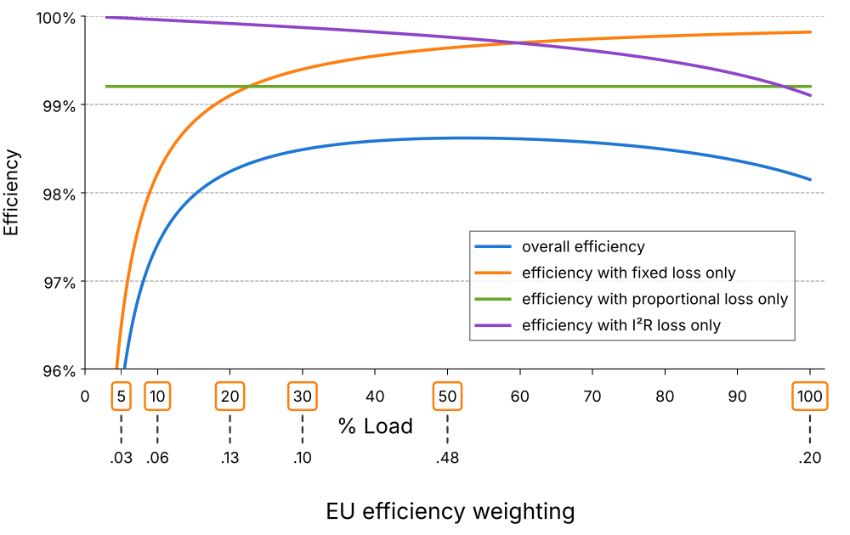
As illustrated above, different loss mechanisms dominate at different load conditions. Fixed switching losses, associated with charging and discharging device capacitances during each switching cycle, have the greatest impact at low load. As load increases, load-proportional switching and conduction losses become dominant before resistive conduction losses gradually take over near rated power. Reducing both switching and conduction losses therefore improves performance across the entire operating range, increasing energy yield and round-trip efficiency over the system lifetime.
Matching WBG devices to renewable energy architectures
WBG devices can improve efficiency and power density across a range of renewable energy applications, but the optimal solution depends on system architecture, operating voltage and long-term reliability requirements.
- Many modern string inverters, central inverters and battery storage converters operate from 800 V to 1000 V DC buses, requiring devices that can maintain efficiency while operating with sufficient voltage headroom. In these applications, 1200 V SiC MOSFETs are widely used throughout inverter and DC/DC conversion stages. Their combination of high blocking voltage, low switching losses and stable RDS(on) behavior over temperature helps maintain efficiency under both full-load and partial-load conditions.
- Lower-voltage systems, such as hybrid and micro solar installations and power optimizers, can benefit from the fast-switching characteristics of GaN FETs, allowing designers to reduce the size of magnetic components and filtering networks while maintaining high efficiency. Emerging inverter topologies, including HERIC and matrix-based architectures, can also leverage both unidirectional and bidirectional GaN FETs to optimize specific converter stages where compact design and high-frequency operation provide the greatest system-level benefit.
Device technology is only part of the design equation. Package selection also influences thermal performance, parasitic inductance and long-term reliability. For high-power string inverters and energy storage converters, packages such as TO-247-4 and D2PAK-7 remain popular because of their power-handling capability and proven thermal characteristics. Meanwhile, top-side cooled solutions such as TOLT, X.PAK and QDPAK help improve heat extraction, minimize PCB thermal stress and support higher power density in compact renewable energy systems.
Package choice, in other words, is inseparable from device choice (Why packaging is driving wide-bandgap power density). Together they determine whether a design meets its energy yield, thermal and reliability targets in the field.
Designing for thermal cycling and grid reliability
Renewable energy systems place continuous thermal stress on power semiconductors throughout their operating life. Solar installations heat and cool each day as generation rises and falls, while battery energy storage systems repeatedly transition between charging, discharging and standby modes. Maintaining stable efficiency across these changing operating states is therefore just as important as achieving a strong peak-efficiency figure. Daily thermal cycling also affects long-term system reliability, making predictable electrical characteristics over temperature essential for consistent system performance throughout the product lifetime.
In addition, grid-connected systems must withstand transient overvoltages, fault events and fluctuating operating conditions without compromising performance. As a result, device selection increasingly focuses on thermal resilience, voltage margin and stable performance across a wide operating range rather than simply minimizing switching losses. Characteristics such as robust avalanche capability and qualified packaging technologies can therefore be as significant as headline efficiency figures when evaluating SiC MOSFETs and GaN FETs for grid-connected energy systems.
Optimizing MPPT performance
Maximum Power Point Tracking (MPPT) stages are fundamental to photovoltaic systems because they continuously optimize energy extraction from solar arrays as irradiance conditions change. Many MPPT implementations use boost converter topologies operating at relatively high switching frequencies, making diode reverse-recovery behavior an important contributor to overall converter efficiency.
In these applications, SiC Schottky barrier diodes based on merged PiN Schottky technology are widely used in boost and freewheeling stages because their low reverse-recovery charge (Qrr) reduces switching stress and improves converter efficiency. Although the efficiency gain from an individual switching event may be small, these improvements accumulate over years of operation, contributing directly to increased energy harvest and improved system economics.
Building for lifetime performance
As photovoltaic generation, battery storage and grid interaction increasingly converge within a common power conversion platform, WBG device selection becomes a system-level optimization exercise. Selecting the right combination of SiC and GaN devices, together with appropriate packaging and gate-drive strategies, enables designers to maximize energy yield, improve thermal resilience and reduce qualification complexity across multiple renewable energy platforms.
For more on Nexperia’s WBG portfolio, check out our Wide-bandgap semiconductors Technology Hub.